
Commercial Pilot License in Los Angeles: 2026 Guide

Published by:
Ari Hovnanyan
Published on:
Updated on:
Read time:
10 min read
The Commercial Pilot License in Los Angeles is where your training starts to feel like a career decision, not just the next certificate on a list.
If you already have your private pilot foundation and you are building toward paid flying, the commercial stage is the point where every hour needs a job. You are planning the path to 250 hours, sharpening precision maneuvers, preparing for the commercial checkride, and deciding what comes next: CFI, multi-engine, or a full airline-track plan.
At ActivePILOT Flight Academy in Van Nuys, our current Commercial Pilot License program range is $9,017 to $9,975 for qualified pilots, with a 1 to 2 month program pace for prepared students who already meet the prerequisites and can train consistently. Your actual cost and timeline depend on your starting hours, proficiency, schedule, weather, aircraft availability, and checkride readiness.
A quick point on terminology: while most students call it a “Commercial Pilot License” or “CPL,” the official FAA credential is a Commercial Pilot Certificate. Both terms describe the same professional milestone, and we will use them interchangeably here.
Your CPL Is The Point Where Training Becomes Professional
A private pilot certificate lets you fly for personal privileges. A commercial pilot certificate can open paid-flying privileges, but only when you are qualified for the aircraft, operation, medical standard, and rules that apply.
That distinction is important. The commercial certificate is not a blanket permission slip for every flying job. It is the FAA credential that moves you into a more professional standard of flying. You must show stronger precision, better planning, and cleaner decision-making than you needed as a private pilot.
In our Commercial Pilot License program, that work includes maneuvers such as chandelles, lazy eights, steep spirals, emergency procedures, commercial cross-country planning, and checkride preparation. The airplane work is only part of it. You also need the judgment to explain why a flight should go, wait, or change.
The FAA’s Airman Certification Standards organize the practical test around knowledge, risk management, and skill. That is why a serious CPL plan should never be only “build hours until the number looks right.” Your training should turn those hours into professional habits.
Clear The Requirements Before You Spend Another Hour
The commercial stage rewards planning. If you wait until the end to check requirements, you can discover that your logbook has hours, but not the right mix of hours.
For most civilian airplane students training under Part 61, the commercial path usually includes these planning points:
| Planning Item | What To Have Ready | Why It Protects Your Progress |
|---|---|---|
| Age and language | Be at least 18 and able to read, speak, write, and understand English | These are baseline eligibility items before the commercial certificate can be issued. |
| Prior certificate | Hold a Private Pilot License or meet another FAA-recognized pathway | The Commercial Pilot License is not the first certificate for a new civilian student. |
| Flight time | Plan around 250 total flight hours for many Part 61 airplane applicants | The number is only the start; cross-country, PIC, night, instrument, and checkride-prep details still matter. |
| Medical planning | Address medical questions early | Exercising commercial pilot privileges in most airplane operations generally requires at least a second-class medical. |
| Written and practical testing | Prepare for the knowledge test and commercial checkride | Your instructor should help you turn requirements into a clean checkride plan. |
If medical eligibility is on your mind, handle it before you spend heavily. Use an Aviation Medical Examiner for personal medical questions. The goal is not to self-diagnose from a blog post; it is to make sure your training plan matches your real eligibility.
You can also use our Flight Training Readiness Assessment before you enroll. It helps our team understand your current certificate, flight hours, schedule, budget, and medical questions before the first planning conversation.
A Zero-To-Commercial Plan Works Best When Each Certificate Has A Job
A strong zero to commercial pilot program is not just a fast calendar. It is a sequence where each certificate prepares you for the next workload.
Here is the career-track sequence most Los Angeles students need to understand:
| Stage | What It Builds | How It Supports The Commercial Goal |
|---|---|---|
| Private Pilot License | Basic aircraft control, solo confidence, navigation, and passenger privileges | Gives you the foundation for all advanced training. |
| Instrument Rating | IFR procedures, scan, radio work, weather judgment, and cockpit organization | Makes commercial privileges more useful and prepares you for higher workload. |
| Commercial Pilot License | Precision maneuvers, professional standards, and paid-flying privileges under the right rules | Moves you from personal flying into career preparation. |
| Certified Flight Instructor | Teaching skill, right-seat discipline, and a common hour-building path | Helps many career-track pilots build experience after commercial. |
| Multi-Engine Rating | Multi-engine aircraft control, engine-out procedures, and PA-30 experience | Supports airline, charter, and advanced professional goals. |
Our Zero-1500 Airline Training Program connects private, instrument, commercial, and instructor training into one larger path. The current path is built around a 7 to 9 month initial training sequence before later hour building toward ATP eligibility. Treat that as a serious full-time planning track, not a casual lesson pace.
That is where evaluating airline pilot training programs in Los Angeles can get confusing. You do not become an airline pilot the day you pass the commercial checkride. Commercial is a major gate, then CFI, multi-engine, time building, ATP eligibility, and hiring standards come later. A clear program should show you how those stages connect without pretending one certificate solves the whole career.
Cost And Timeline Need More Than One Price Range
Commercial training has two different cost questions.
The first is simple: what is the current program range? At ActivePILOT, our current Commercial Pilot License program range is $9,017 to $9,975 for the CPL phase.
The second question is more important: what do you bring into the program? A pilot who arrives with a clean logbook, strong instrument habits, steady availability, and the right hour mix is in a different position than a pilot who still needs major time building.
Use this planning view before you compare schools:
| Cost Or Timeline Factor | What It Changes | How We Help You Plan |
|---|---|---|
| Starting flight hours | Determines how close you are to the 250-hour commercial benchmark | We review your certificate stage, logbook, and target next step. |
| Lesson frequency | Affects skill retention and calendar pace | We help you build a schedule that supports consistent flying. |
| Ground preparation | Reduces wasted aircraft time | You should know the maneuver, standard, and lesson objective before engine start. |
| Aircraft and instructor availability | Shapes how often you can fly | Our fleet and rental options give you current aircraft paths to discuss. |
| Checkride readiness | Determines when your instructor recommends the practical test | The goal is to arrive ready, not rushed. |
Our financial model is built to reduce up-front friction. With pay-as-you-go training and financing options, you are not forced into one large deposit before every lesson is flown. Financing options may also be available to qualified applicants through partners including Stratus Financial, AOPA Financing, and Columbia Bank.
If you are still comparing the full investment, review our Pilot Training Costs and FAQ and then talk with us about your current hours. CPL cost planning is much cleaner when the conversation starts with your actual logbook.
Van Nuys Gives Commercial Training More Real-World Texture
Commercial training is not only about flying a maneuver inside tolerances. You also need to manage cockpit workload while the airport, radio, airspace, and timing keep moving.
That is one reason our Van Nuys Airport location is part of the training value. At KVNY, you train in a professional airport environment where radio work, taxi discipline, traffic awareness, and planning are part of the normal rhythm. Those repetitions help you build the calm, organized habits expected of a commercial pilot.
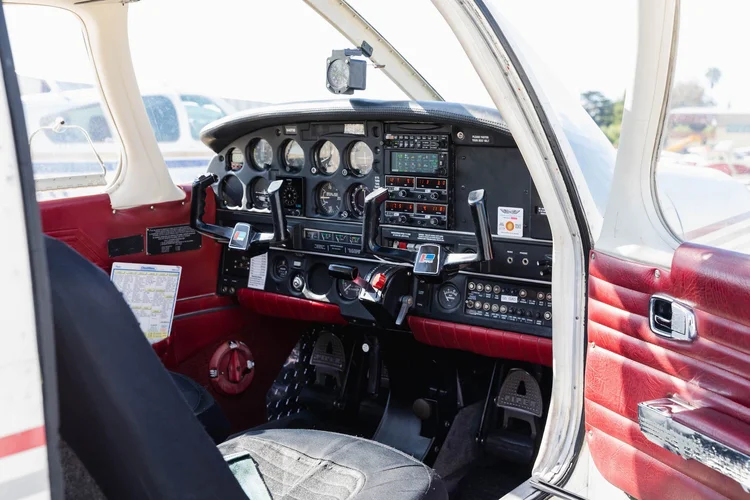
Aircraft choice also matters. Our current aircraft rental and training fleet includes PA-28 aircraft for single-engine training and a PA-30 Twin Comanche for multi-engine training. For commercial students, cockpit familiarity helps protect lesson time. When the airplane setup is familiar, you can spend more attention on precision, planning, and decision-making.
Active students also get access to our X-Plane simulator as a practice tool. It is not a replacement for required aircraft training, and it should not be treated as FAA-credit time unless the session and device meet the exact rule for that use. Its value is repetition. You can rehearse flows, radio calls, instrument scan, and task order before paying aircraft rental for every reset.
Know What The Commercial Certificate Opens And Where It Stops
The commercial certificate changes your options. It can let a properly qualified pilot act as pilot in command for compensation or hire under the applicable rules. That is the threshold many students have been working toward since the first discovery flight.
Still, the certificate does not replace every other requirement. A job can require the right aircraft category and class, instrument privileges, a second-class medical, company training, insurance approval, operational rules, and more experience. Some roles also need instructor privileges, multi-engine time, or other qualifications.
Think of the CPL as the professional doorway, not the entire building.
After commercial training, many ActivePILOT career-track students look at three next moves:
- Add or sharpen the Instrument Rating if the commercial path exposed IFR gaps.
- Move into Certified Flight Instructor training to prepare for teaching and common hour-building work.
- Add the Multi-Engine Rating to build experience in a PA-30 and prepare for more advanced aircraft.
For students focused on an airline path, the later ATP benchmark is often summarized as 1,500 hours, but ATP eligibility includes more than total time. The FAA’s ATP training guidance also separates standard ATP planning from restricted-privileges ATP paths. We will help you keep those milestones separate so your CPL plan stays realistic.
FAQ: Commercial Pilot Training In Los Angeles
How much does a Commercial Pilot License cost at ActivePILOT?
Our current Commercial Pilot License program range is $9,017 to $9,975 for qualified pilots in the CPL phase. Your final training investment depends on your starting hours, preparation, proficiency, schedule, weather, aircraft availability, and checkride readiness. You can also review financing options before you choose a pace.
How long does commercial pilot training take in Los Angeles?
Our current CPL program is built around a 1 to 2 month pace for prepared students who already meet the prerequisites and can train consistently. If you still need significant hour building before reaching the commercial requirements, your calendar will be longer. The cleanest next step is a logbook and schedule review through our request information form.
Do I need an instrument rating before commercial training?
Many career-track pilots earn the Instrument Rating before commercial training because it builds cockpit organization and reduces commercial privilege limits tied to passenger-for-hire operations. Your exact sequence should match your current certificate, category, class, and goals.
Can I start from zero and become a commercial pilot?
Yes, but you do it in stages. The usual civilian path starts with Private Pilot License training, then instrument, then commercial. Our Zero-1500 program connects those stages for students who want a career-track path from the beginning.
Does a commercial pilot certificate get me an airline job?
No. The CPL is a major career step, but airline eligibility and airline hiring are later milestones. Many pilots continue into CFI training, multi-engine training, and time building before ATP eligibility and airline applications.
What should I do before enrolling in a CPL program?
Start by confirming your current certificate, flight hours, medical path, budget, and weekly availability. If you are unsure where you stand, complete the Flight Training Readiness Assessment so our team can help you compare your current position with the commercial pilot path.
Plan Your Commercial Pilot Path With ActivePILOT
Commercial training is a serious step. It is where your logbook, budget, schedule, and career goal need to line up before you keep spending aircraft hours.
If your goal is a Commercial Pilot License in Los Angeles, start with a planning conversation. We will help you compare your current certificate, flight hours, financing options, aircraft path, and next certificate so you know whether the CPL phase, the Zero-1500 path, CFI training, or multi-engine training should come next.
Request information from ActivePILOT and we will help you map the cleanest path from your current cockpit to the commercial checkride.


