.CbLPZiMB_Z2HPxB.webp)
How to Become a Pilot in California: Requirements & Training Timeline

Published by:
Ari Hovnanyan
Published on:
Updated on:
Read time:
10 min read
Three things stop most people from starting pilot training before they ever pick up the phone. They assume they need a college degree. They assume California has its own complicated rules. And they are not sure whether their age, health, or citizenship status disqualifies them before they even begin.
All three assumptions are wrong.
Pilot licensing in the United States is governed entirely by the FAA, meaning California does not have separate pilot licensing requirements. The rules in Los Angeles are the same as the rules in Dallas or Denver. And the FAA’s requirements for age, medical fitness, and eligibility are far more accessible than most people expect.
This guide covers every requirement to become a licensed pilot in California, detailing what you need to qualify, what the full training path looks like from student pilot to airline captain, and why Southern California is one of the strongest places in the country to train.
No Degree Required: What the FAA Actually Asks For
The single most common misconception about pilot training is that you need an aviation degree. You do not.
The FAA requires:
- Minimum age (varies by certificate level, with more details below)
- A valid FAA Medical Certificate from an authorized Aviation Medical Examiner
- English proficiency requiring that you be able to read, speak, write, and understand English
- A Student Pilot Certificate before your first solo flight, obtained through the FAA’s IACRA system
- Passing a knowledge test and practical test for each certificate level
That is the complete list. No academic degree. No prior military service. No aviation background. You start where you are.
If you want to fly for a U.S. airline under Part 121 operations, you will eventually need an Airline Transport Pilot (ATP) certificate, which requires 1,500 total flight hours and a minimum age of 23 on the standard civilian path. The airlines themselves may have additional hiring preferences, and some look favorably on four-year degrees, but the FAA does not require one to earn any pilot certificate.
Age Requirements: When Can You Start?
Each pilot certificate has its own age minimum. Here is where the legal thresholds sit:
| Certificate | Minimum Age | What It Unlocks |
|---|---|---|
| Student Pilot Certificate | 16 (powered aircraft) | Legal to fly solo |
| Private Pilot License | 17 | Fly passengers, non-commercial |
| Instrument Rating | 17 (concurrent with or after PPL) | Fly in clouds and low visibility |
| Commercial Pilot License | 18 | Get paid to fly |
| Multi-Engine Add-On | 18 (with CPL) | Fly twin-engine aircraft commercially |
| CFI / CFII | 18 | Teach other pilots, build hours |
| ATP Certificate | 23 (standard path) | Fly for an airline under Part 121 |
There is no upper age limit to earn a pilot certificate. The FAA does not cap when you can start or finish training. Medical fitness, rather than age, determines whether you can hold a certificate at any point in your training or career.
The FAA Medical: Three Classes, One AME Appointment
Before your first solo flight, and at each subsequent certificate level, you need a valid FAA Medical Certificate issued by an Aviation Medical Examiner (AME). The exam covers vision, hearing, blood pressure, coordination, and general health.
The FAA issues three classes of medical certificates, and the class you hold determines what you can legally do as a pilot:
| Medical Class | Required For | Issued By |
|---|---|---|
| Third-Class | Student pilot solo, Private Pilot operations | AME appointment |
| Second-Class | Commercial Pilot operations | AME appointment |
| First-Class | ATP certificate, airline operations | AME appointment (stricter standards) |
Our recommendation: If you are starting training with any intention of a professional career, apply for a First-Class Medical Certificate at your very first appointment. A Third-Class is sufficient to solo and earn your Private Pilot License, but if you invest thousands of dollars in commercial training only to discover you cannot meet First-Class standards, you cannot work as an airline pilot. Catching that early costs one appointment. Catching it late costs a career.
Corrective lenses are permitted at all three medical class levels. Many common health conditions are manageable through FAA Special Issuance processes. If you have a medical history you are concerned about, speak with an AME before your appointment, not after. Our team can connect you with local Aviation Medical Examiners in the Van Nuys area.
English Proficiency: What the FAA Requires
The FAA requires all pilot certificate applicants to read, speak, write, and understand English. This applies at every level, from Student Pilot Certificate through ATP.
For international applicants, this means aviation-level English competency. You do not need to pass a separate English exam to apply for an FAA certificate, but you must be able to understand and respond to ATC communications, read weather briefings and NOTAMs, complete written applications, and communicate with your flight instructor effectively.
At ActivePILOT Flight Academy at Van Nuys Airport, we train pilots from a wide range of international backgrounds. English is the language of U.S. airspace and the language of our instruction.
International and Foreign National Pilots: The AFSP Step
If you are not a U.S. citizen or U.S. national, there is one additional step before you can begin flight training in the United States: the TSA Alien Flight Student Program (AFSP).
Under federal law, non-U.S. citizens must apply through the AFSP and receive TSA approval before starting flight training in a powered aircraft. This is a security clearance process, not a skills test. It involves a background check and application review by TSA. Approval must be in place before your first flight lesson, not after.
This requirement applies regardless of which country you are from or what visa type you hold. The processing timeline and specific requirements depend on your training type and citizenship. We recommend contacting us before enrolling so we can walk you through the AFSP process and timeline for your specific situation.
U.S. citizens also go through TSA identity vetting as part of the standard IACRA Student Pilot Certificate application, but this process is integrated into the normal FAA paperwork and does not require a separate AFSP application.
For European pilots holding an EASA license who want to convert to an FAA certificate, we have a dedicated guide covering both the 14 CFR 61.75 path and the full conversion process in our EASA to FAA conversion guide.
The Full Pilot Training Ladder: Student to Airline
Here is what the complete path from zero experience to a professional aviation career looks like, with the minimum FAA requirements and what each certificate unlocks:
Student Pilot Certificate
Apply through the FAA’s IACRA system with your flight instructor’s verification. No flight test required — just identity vetting, a health questionnaire, and TSA processing. Typical wait: three to four weeks. Get this started as early as possible in your training, as it must be in hand before your first solo flight.
You can begin dual flight instruction before this is issued. You just cannot fly solo until it arrives.
Private Pilot License (PPL)
Minimum: 17 years old, Third-Class Medical, 40 flight hours (Part 61), pass FAA Knowledge Test and practical test.
The PPL is your first full certificate. It allows you to fly passengers, travel cross-country, and fly under Visual Flight Rules (VFR). Most students in Southern California complete their PPL in 50 to 70 flight hours with consistent training.
At ActivePILOT, the PPL program ranges from $15,061 to $16,219. For a detailed look at the step-by-step training process, read our Private Pilot License guide for Los Angeles.
Instrument Rating (IR)
Minimum: 17 years old, PPL, 40 hours of instrument flight time, 50 hours of cross-country PIC time.
The Instrument Rating allows you to fly in clouds, low visibility, and instrument meteorological conditions. Airlines will not hire you without one, as it is the bridge between recreational and professional flying. Our IR program ranges from $16,078 to $17,350.
Commercial Pilot License (CPL)
Minimum: 18 years old, Instrument Rating, 250 total flight hours.
With a CPL, you can get paid to fly. Charter, aerial work, corporate operations, and flight instruction all require a commercial certificate. Our CPL program ranges from $9,017 to $9,975.
Multi-Engine Add-On
Minimum: CPL or PPL (depending on target privileges), practical test in a multi-engine aircraft.
Required to fly twin-engine aircraft commercially. Our accelerated multi-engine course uses the Piper PA-30 Twin Comanche at $320/hr, making it one of the most cost-competitive multi-engine trainers in the Los Angeles market.
Certified Flight Instructor (CFI / CFII / MEI)
Minimum: 18 years old, CPL, Instrument Rating (for CFII).
The CFI certificate is how most pilots build the 1,500 hours required for the ATP while earning a paycheck. Flight instruction is one of the most common and practical paths to the airlines. Our CFI program is structured around a 30-day academy ranging from $7,759 to $9,480.
Airline Transport Pilot (ATP)
Minimum: 23 years old (standard path), 1,500 total flight hours, First-Class Medical.
The ATP certificate is required to serve as pilot-in-command of an airliner under Part 121 operations. Some military and degree-program paths allow eligibility at 21, but the 1,500-hour and age-23 requirements apply to the standard civilian path that most pilots follow.
Our Zero-1500 Airline Training Program takes you from zero flight time through every certificate, including PPL, IR, CPL, Multi-Engine, and CFI, in a structured 19-to-25-month sequence. After that, you build your remaining hours as an instructor and pursue airline hiring.
Why Southern California Is One of the Best Places to Train
The FAA rules are the same everywhere in the United States. What changes is the training environment, and that difference is real.
Flying days. Southern California’s climate gives student pilots in Los Angeles more flyable training days per year than most of the country. Weather cancellations slow students down and inflate total training costs. In the Los Angeles basin, the window is consistently wide.
Airspace complexity. Van Nuys Airport (KVNY) operates inside Class D airspace, immediately adjacent to the Class B airspace of Los Angeles International Airport. You practice real ATC coordination, real traffic patterns, and real radio discipline from your very first lesson. Pilots who train in low-traffic environments often struggle with busy airspace for the first time in their careers. At KVNY, you are already comfortable with it before you earn your certificate.
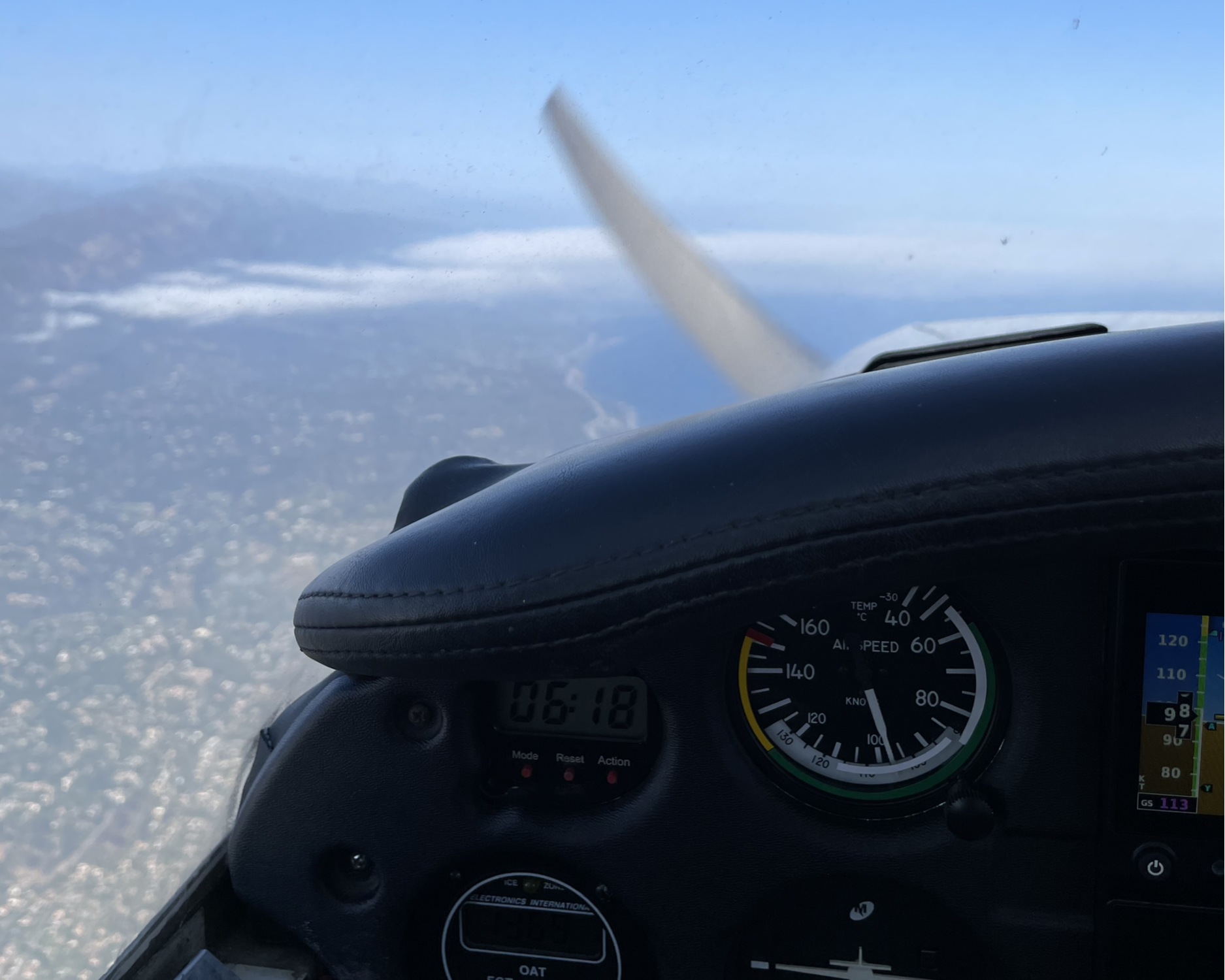
Geographic range. Within a short flight of Van Nuys, you have the San Gabriel Mountains for high-density altitude and terrain work, the Pacific Coast for marine layer and over-water operations, and the high desert for crosswind and hot-weather flying. That variety is built into your training, not an optional extra.
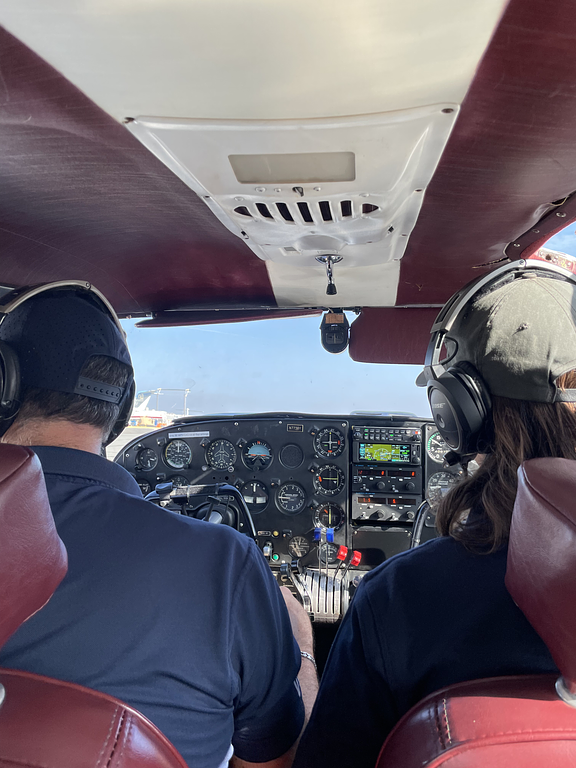
Fleet access. We operate the largest fleet of Piper Warrior aircraft at Van Nuys Airport. Aircraft availability is one of the most underrated factors in how quickly a student progresses, and how much their training ultimately costs. When you are ready to fly, an aircraft is ready for you.
Checkride timing. One of the most damaging hidden costs in Los Angeles flight training is the wait for a Designated Pilot Examiner (DPE). Many schools report three-to-four-month waits. We maintain relationships with three DPEs, which brings our students’ checkride scheduling to approximately one month from readiness to test day. Months of waiting means months of paying for currency flights.
How to Budget for Pilot Training in California
Flight training is a real financial commitment. The total cost from zero hours to ATP depends on how you build your hours and which programs you choose. The full path, from PPL through CFI and hour-building to 1,500 hours, typically requires budgeting between $80,000 and $120,000 over the course of the training and hour-building period.
We operate on a pay-as-you-go model, requiring no mandatory large advance deposits. You pay for the flight hours you fly, tracked transparently. If you want to spread the cost over time, we work with three lending partners: Stratus Financial, AOPA Finance, and Columbia Bank. You can review financing options on our financing page.
Starting with the PPL only? The program range is $15,061 to $16,219. You do not need to commit to the full path on day one.
Frequently Asked Questions
Do I need to be a U.S. citizen to train at a California flight school?
No. Non-U.S. citizens can train at any FAA-certificated U.S. flight school, including ActivePILOT at Van Nuys Airport. However, you must complete the TSA Alien Flight Student Program (AFSP) and receive TSA approval before beginning flight training. Contact us before enrolling so we can help you understand the AFSP timeline and requirements for your situation.
What if I have a medical condition, can I still become a pilot?
Possibly, depending on the condition and the certificate level you are pursuing. Many conditions that seem disqualifying are managed through the FAA’s Special Issuance process. Corrective lenses are permitted. The right first step is a conversation with an Aviation Medical Examiner (AME) before you enroll, not after. We can connect you with local AMEs in the Van Nuys area.
Is there an upper age limit to become a pilot?
No. The FAA does not impose an upper age limit to earn a pilot certificate. Age 60 is the mandatory retirement age for airline pilots under Part 121, but there is no age cap on earning a certificate or flying recreationally.
How long does it take to go from zero to airline-ready?
On a structured full-time schedule, the path from zero flight hours through CFI certification takes approximately seven months. Building from 250 hours to 1,500 hours as a flight instructor typically takes an additional 12 to 18 months. Our Zero-1500 Program structures the full sequence into a 19-to-25-month timeline.
Can I train part-time while working?
Yes. Under Part 61, your training schedule is flexible, allowing us to adapt lessons around work and personal commitments. Students who train two to three times per week typically complete their Private Pilot License in three to six months. Career-track students who want to move quickly often train more intensively.
What is the difference between a Private Pilot License and a Commercial Pilot License?
A Private Pilot License (PPL) allows you to fly for personal use and carry passengers, but not for compensation. A Commercial Pilot License (CPL) allows you to be paid to fly. Airlines require the ATP certificate, but the CPL is the required step before the ATP path.
Do I need my own headset and equipment?
Most students purchase a headset early in training. We can recommend options that fit the Piper Warrior cockpit and your budget. There is no requirement to own your own equipment before your first flight.
Ready to Find Out If This Is Your Path?
The requirements to become a pilot in California are the same federal requirements that apply everywhere in the United States. They are specific, achievable, and not contingent on a degree or prior aviation experience.
The first step is a Discovery Flight at Van Nuys Airport. For $249, you fly the aircraft, see the training environment, and leave with a clear picture of what your path looks like from where you stand today.
.CCh9zi8h_Zkhw5v.webp)


