.0sOCQrdD_ZNLx5N.webp)
CFI Training Los Angeles: 2026 Guide to Pass the Checkride and Build Hours

Published by:
Ari Hovnanyan
Published on:
Updated on:
Read time:
8 min read
The first time you sit in the right seat as the instructor, the airplane feels different.
You already know how to fly. You have passed private, instrument, and commercial training. But now the job is bigger. You must explain the maneuver, watch the student, guard the controls, manage the radio, and keep the lesson moving without taking over too soon.
That is why CFI training in Los Angeles is not just another checkride prep course. It is the point where you stop proving that you can fly and start proving that you can teach.
At ActivePILOT Flight Academy at Van Nuys Airport, our CFI program is built for commercial pilots who want a clear path from checkride prep to real instructor capability. For the full overview of prerequisites, cost, and next steps, start with our CFI training in Los Angeles page, and skim the CFI training FAQs if you want quick answers first.
If your goal is the airlines, this step also matters because flight instructing is one of the most common ways pilots build time toward the standard 1,500-hour ATP benchmark. Exact ATP eligibility includes more than total time, and some pilots follow restricted-ATP paths, but the 1,500-hour mark is still the planning target many career-track pilots use.
Your CFI Checkride Tests Teaching, Not Just Flying
The initial CFI checkride has a tough reputation for a reason. The flying maneuvers are familiar, but the standard is different. A commercial pilot can perform a steep turn. A flight instructor must explain it, demonstrate it, detect errors, correct the student, and keep the airplane safe while doing all of that.
That is the shift our Certified Flight Instructor program is designed to make. The checkride is not only a test of knowledge. It is a test of organized teaching under pressure.
In practice, that means you need to be ready to:
- Teach FAA concepts in plain language.
- Explain why a maneuver matters, not just how to perform it.
- Brief risks before they show up in the airplane.
- Use lesson plans without sounding like you are reading a script.
- Manage a student’s mistakes without losing control of the lesson.
- Speak clearly while flying from the instructor seat.
The goal is not to memorize hundreds of pages and hope the oral exam goes your way. The goal is to build a repeatable teaching method before you meet the examiner.
A 30-Day Training Plan Gives Your Prep a Daily Structure
Most CFI candidates do not struggle because they are lazy. They struggle because the workload is wide open. Lesson plans, FOI concepts, endorsements, regulations, technical subject areas, right-seat flying, and checkride prep all compete for attention.
Our CFI program narrows that chaos into a structured sequence. The current program includes:
| Training Block | What You Get | Why It Matters |
|---|---|---|
| Certified Flight Instructor program classroom training | 104 hours of classroom instruction | You build the knowledge base and teaching vocabulary needed for the oral exam. |
| Certified Flight Instructor program one-on-one ground | 10 hours of individual ground instruction | You refine your teaching style with direct feedback instead of guessing alone. |
| Certified Flight Instructor program flight training | 14 hours of flight time | You learn to teach maneuvers from the right seat while maintaining safety and control. |
| Certified Flight Instructor program simulator training | 6 hours of dual simulator time | You rehearse cockpit flow and teaching cadence before the airplane workload rises. |
If you are mapping your calendar, our 2026 CFI timeline guide breaks down how long each phase takes and what stretches it.
That structure matters because CFI prep is not only about more study time. It is about using the right kind of repetition. You need classroom reps for knowledge, ground reps for lesson delivery, simulator reps for cockpit flow, and flight reps for real right-seat teaching.
If you are comparing a flight instructor course in Los Angeles, ask how the school turns the CFI workload into daily work. A vague “come prepared” plan puts too much weight on the student. A structured academy gives you a path to follow.
Checkride Scheduling Can Make or Break Your CFI Timeline
Finishing your training is only half the battle. The other half is getting in front of an examiner. In many parts of the country, that wait is where momentum dies. Pilots finish their prep, then sit for weeks or months waiting for an available checkride slot, and their sharpest knowledge fades before test day arrives.
This is one of the quieter reasons CFI training in Los Angeles timelines vary so much from school to school. A polished lesson-plan binder does not help if the schedule stalls.
At ActivePILOT, our long-standing relationships with several Designated Pilot Examiners (DPEs) are built to keep that momentum alive. The advantage is scheduling access, not a shortcut around the standard. You still have to earn the certificate. But when you finish your prep sharp and ready, we want a checkride date within reach rather than a month of waiting that dulls your edge.
When you compare a flight instructor course in Los Angeles, ask two questions most students forget: How quickly can I get on the examiner’s calendar, and what happens to my prep if that wait stretches out? A school that owns its checkride scheduling is protecting your timeline, your money, and your confidence.
Lesson Plans Should Help You Teach, Not Bury You
Many CFI candidates lose momentum before the airplane even starts. They open a blank document, realize how many lesson plans they need, and start building a binder that gets larger but not clearer.
Lesson plans matter. But a lesson plan is not the goal. The goal is for you to walk into a checkride and teach with sequence, accuracy, and calm control.
In our CFI training, a structured lesson-plan framework keeps you from starting on a blank page. You still need to know the material. You still need to make the lesson your own. But the framework helps you focus on what the examiner and future students actually need:
- The objective of the lesson.
- The common errors a student will make.
- The risk points that need a clear briefing.
- The demonstration sequence.
- The questions that prove understanding.
- The standard for completion.
That is where peer teaching becomes useful. Before the pressure of the practical test, you need reps explaining stalls, slow flight, landings, airspace, weather, endorsements, and aircraft systems to another person. Those reps expose weak spots fast. If your explanation is unclear in front of a classmate, it will be unclear in front of an examiner.
The advantage of training at Van Nuys Airport is that your examples do not have to stay abstract. You can connect each lesson to real radio calls, runway flow, traffic patterns, and Southern California airspace decisions.
The Right-Seat Transition Changes How You Use the Airplane
Commercial training rewards precision. CFI training adds restraint. You must let the student work, but you cannot let the lesson drift into an unsafe or confusing place.
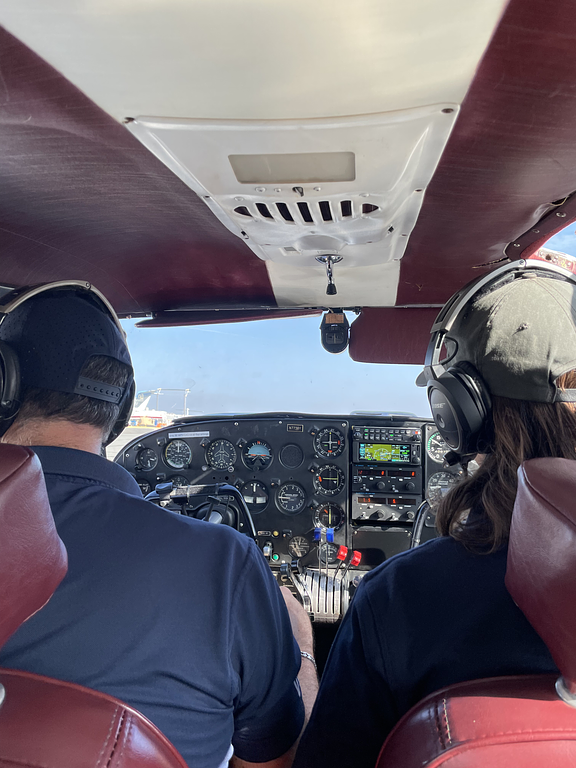
That is why the 14 flight hours in our CFI program are focused on more than maneuver polish. You are learning how to teach from the right seat. That includes when to speak, when to demonstrate, when to pause, and when to take the controls.
Our standardized Piper PA-28 training fleet helps here. When the cockpit layout and flows are consistent, you spend less energy adapting to a new airplane and more energy building instructor habits. You can also review our aircraft rental and training fleet if you want to understand the aircraft you may train around before starting the academy.
The 6 hours of dual simulator time also serve a specific purpose. Active students get free access to our basic, non-FAA-approved X-Plane simulator for extra practice, and the CFI program includes dual simulator work to rehearse cockpit flow and teaching rhythm. The simulator is not a replacement for required aircraft training, but it is a useful place to slow down the lesson and clean up your words before the airplane demands more attention.
If cockpit workload is one of your biggest concerns, our simulator training resources can help you practice flows between lessons without paying aircraft rental for every repetition.
CFII Training Makes You More Useful to Instrument Students
Many career-track pilots start with CFI and then add instrument instructor privileges, often called CFII. The term is common in the industry, but the practical meaning is simple: you are preparing to teach instrument students within the privileges and limits of your instructor certificate and ratings.
That matters for hour building because instrument students need a different kind of instructor. They need someone who can teach scan, procedure setup, weather judgment, ATC communication, missed approaches, and task management when the outside view is no longer the main reference.
If you are researching CFII training in Los Angeles, think beyond the rating name. Ask whether your school can help you build the teaching discipline instrument students need. At ActivePILOT, that discipline connects naturally with our Instrument Rating program, our Garmin-equipped PA-28 training environment, and our simulator practice culture.
For the right pilot, adding CFII can make you more versatile as an instructor. It does not guarantee a job or a fixed number of hours, but it can broaden the kind of students you are prepared to teach.
Van Nuys Gives Your Teaching Real-World Context
Where you earn your certificate shapes the kind of instructor you become. Certified flight instructor training at a quiet, uncongested field is comfortable, but it does not stretch you the way a busy environment does.
Van Nuys Airport (KVNY) is one of the busiest general aviation airports in the world, with parallel runways, dense traffic, and complex Southern California airspace on every flight. As a student here you learned to manage that workload. As an instructor, you now have to teach it, narrating radio calls, runway assignments, and traffic decisions while a newer pilot is still overwhelmed by them.
That is a real advantage when you move into CFII training in Los Angeles as well. Instrument students in this airspace need an instructor who can calmly talk through clearances, approaches, and missed-approach decisions in a system that does not slow down for a first attempt. Teaching those flows where they actually happen builds instructor judgment faster than any textbook can.
It also makes you more employable. A CFI who is fluent in busy-airspace instruction is prepared for a wider range of schools and students than one who only ever taught in calm conditions.
Building Hours Works Best When Teaching Opportunities Are Realistic
The biggest career bottleneck for many commercial pilots is not passing one more test. It is building time in a way that does not require paying out of pocket for every hour.
Flight instruction is one of the most common solutions because you can earn while you build experience. You are not just renting an airplane to watch the logbook grow. You are teaching students, sharpening your own standards, and gaining the cockpit judgment that comes from seeing common mistakes before they become serious problems.
Still, this part needs to be stated plainly: a CFI certificate is not an automatic job. Teaching opportunities depend on school needs, instructor standards, student demand, aircraft availability, schedule reliability, and how well you fit the role.
At ActivePILOT, the advantage is that you train inside a busy career-focused school with a steady flow of students and a standardized fleet. Qualified CFI program graduates may have a clearer path to teaching opportunities here when staffing needs and standards align. That is a stronger path than finishing a course and then having to start your job search from zero.
If your goal is the Zero-1500 Airline Training Program pathway, the instructor stage is where your career plan becomes practical. You are building toward airline-track experience while becoming the kind of pilot who can explain decisions, manage risk, and communicate under pressure.
Cost, Financing, and Schedule Need to Be Clear Before You Start
CFI training is a serious investment. Our current Certified Flight Instructor program range is $7,759 to $9,480, with a 30-day structure for prepared students who can train consistently.
The cost works best when you understand what the program is designed to do. You are not paying only for aircraft time. You are paying for a system that helps you turn commercial-pilot knowledge into teachable lessons:
- Classroom structure for knowledge depth.
- One-on-one ground instruction for teaching style.
- Flight time for right-seat instruction.
- Simulator time for flow and communication practice.
- Checkride preparation focused on delivery, not panic.
We also use a pay-as-you-go model, so you are not forced into a large advance deposit before every lesson is flown. For pilots who want to move faster, flight training financing may be available through partners including Stratus Financial, AOPA Financing, and Columbia Bank.
Before you enroll, be honest about your schedule. A 30-day CFI academy rewards consistency. If you can study, teach, fly, and review at a steady pace, the structure works in your favor. If your schedule is scattered, you may need a different plan before you start.
Who Is Ready for CFI Training at ActivePILOT?
Our CFI program is built for pilots who are ready to work. Before starting our CFI course, you should be at least 18 years old, hold a commercial pilot certificate with an instrument rating, hold a valid FAA 3rd Class Medical Certificate or higher, and have at least 250 logged flight hours.
Those are the entry points. The deeper requirement is mindset.
You are ready for certified flight instructor training when you can say:
- You want to teach, not only build time.
- You can study daily during the course.
- You are willing to receive direct feedback on your delivery.
- You can explain aviation concepts in plain language.
- You understand that safety comes before speed.
- You want an instructor path that connects to a larger career plan.
If that sounds like the stage you are in, CFI training can be the turning point. It changes your role in the cockpit. It also changes how future employers may see you, because instructing builds communication, judgment, discipline, and responsibility.
FAQ: CFI and CFII Training in Los Angeles
For a fuller list of answers on cost, timeline, prerequisites, and CFI vs CFII, visit our CFI training FAQs.
How long is ActivePILOT’s CFI program?
Our Certified Flight Instructor program is structured around a 30-day training plan for prepared students who can train consistently. Your actual pace depends on readiness, schedule, weather, aircraft availability, and checkride timing.
How much does CFI training cost at ActivePILOT?
The current CFI program range is $7,759 to $9,480. You can also review financing options if you want to compare pay-as-you-go training with aviation lending partners.
Does ActivePILOT guarantee a CFI job after graduation?
No blog post should promise that. A CFI job depends on qualifications, school standards, staffing needs, student demand, and fit. What we can say is that training inside a busy school gives qualified graduates a more practical path to teaching conversations than training in isolation.
Is CFII training worth it after CFI?
For many career-track instructors, yes. CFII training can prepare you to teach instrument students, which may broaden the kind of instruction you can provide. It still depends on your certificate, ratings, school needs, and student demand.
Do I need to write all CFI lesson plans from scratch?
You need to understand and own your lesson plans, but you should not have to face the process with no structure. CFI training should use a lesson-plan framework and peer-teaching practice so your plans become usable teaching tools.
Is the CFI checkride really that hard?
It is demanding because the examiner is evaluating whether you can teach safely and clearly, not just whether you can fly the maneuver. The right preparation focuses on lesson delivery, student-error correction, and cockpit management from the instructor seat.
Start Your Instructor Path at Van Nuys
If you are a commercial pilot ready to move from the left seat to the instructor seat, your next step is not more vague studying. It is a structured plan.
Our CFI program at Van Nuys Airport gives you the classroom time, one-on-one instruction, flight training, simulator practice, and teaching reps needed to prepare for the CFI checkride with purpose. You can review the full path, prerequisites, and pricing on our CFI training in Los Angeles page.
Request information from ActivePILOT and we will help you compare your current qualifications, schedule, financing options, and next available path into CFI or CFII training.


.B93hxYof_19tRkW.webp)

.CbLPZiMB_Z2HPxB.webp)