
Inside Instrument Flight Training: What You Do in the Plane, Sim and Classroom in 2026

Published by:
Ari Hovnanyan
Published on:
Updated on:
Read time:
8 min read
The first time your instructor says “foggles on,” the horizon disappears. Your world shrinks to a panel of instruments, a radio, and a voice from the right seat. That moment is the start of instrument flight training, and most students wonder what the weeks after it actually look like.
In our Instrument Rating program, you split your time across three places: the airplane, the simulator, and the classroom. Each one has a different job. This guide walks through a normal day in each so you know what to expect before your first lesson.
How the Program Splits Your Time
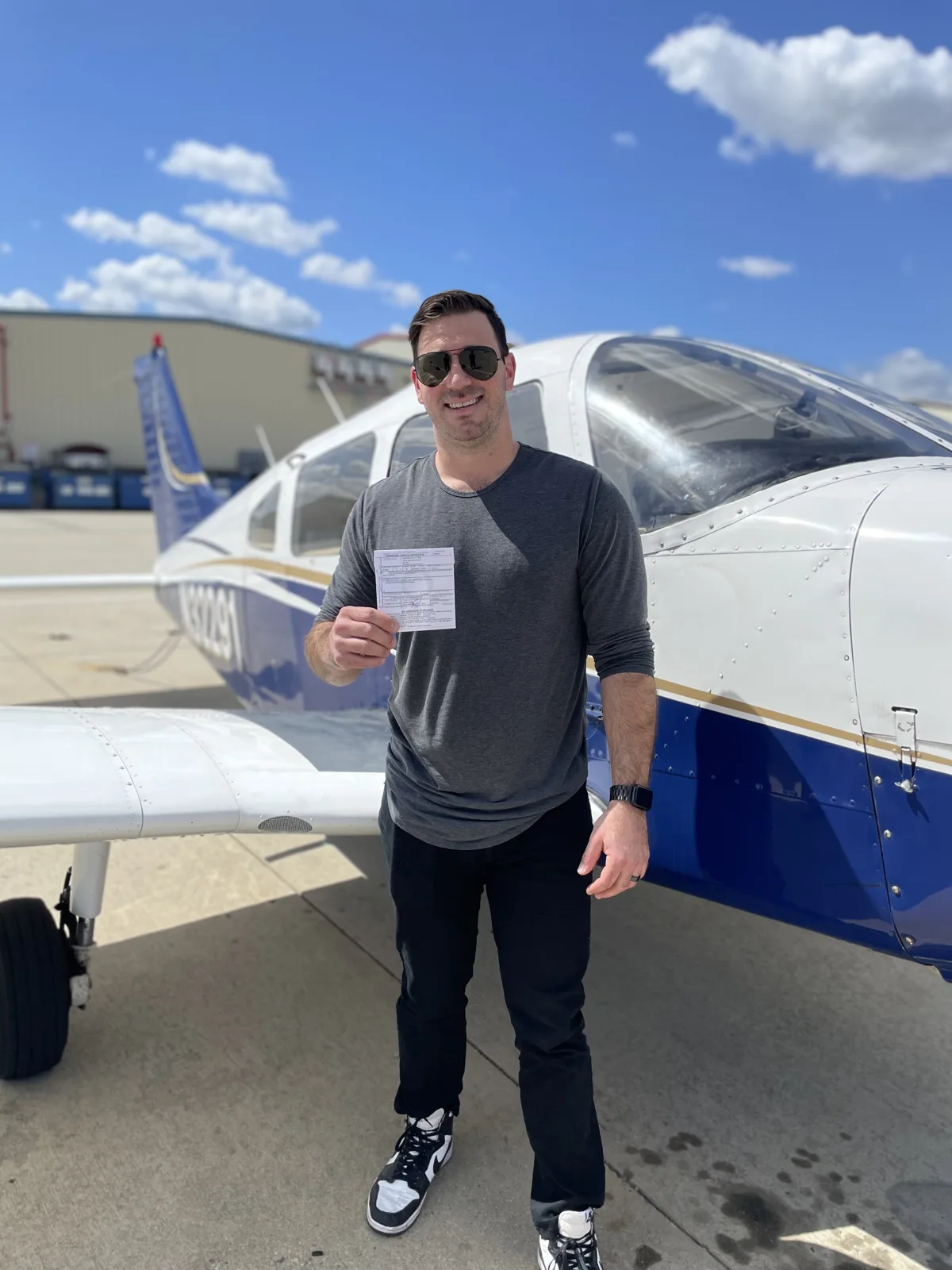
Our program plans for 50 hours of flight time in a Piper Warrior, 30 hours of ground training in the classroom, and 15 hours of online video lessons. On top of that, active students get free time on our X-Plane simulator with PilotEdge.
| Setting | Time in our program | Its main job |
|---|---|---|
| Airplane | 50 hours of flight time | Build real skill and log required experience |
| Classroom | 30 hours of ground training | Understand rules, weather, and procedures |
| Online video | 15 hours | Review topics at your own pace |
| Simulator | Free for active students | Rehearse procedures before you fly them |
The pattern that works is simple: learn it in class, rehearse it in the sim, fly it in the airplane. Students who follow that order spend their airplane hours flying instead of figuring things out. Our instrument rating cost breakdown shows why that matters for your budget.
A Typical Lesson in the Airplane
Every flight starts with a briefing on the ground. Your instructor explains the goal, for example two holding patterns and an approach, and you talk through the plan, the clearance you expect, and what you will do if something goes wrong.
After takeoff, you put on a view-limiting device so you can only see the instruments. You fly the airplane by the panel while your instructor watches traffic outside. Early lessons focus on climbs, turns, and recovering from unusual attitudes. Later lessons add navigation, holds, and approaches into nearby airports.
Flying out of Van Nuys adds something you cannot practice at a quiet field: real air traffic control from the first lesson. You copy clearances, read them back, and handle frequency changes while flying by instruments. That workload is exactly what the checkride, and real IFR flying, will ask of you.
Our instrument trainers include glass-equipped Piper Warriors such as N40057, with dual GI-275 displays, a Garmin GNX 375, and a GFC 500 autopilot, and N41380, with dual Garmin G5s and a Garmin G650. The lesson ends with a debrief, where you and your instructor review what went well and what to practice before next time.
A Typical Session in the Simulator
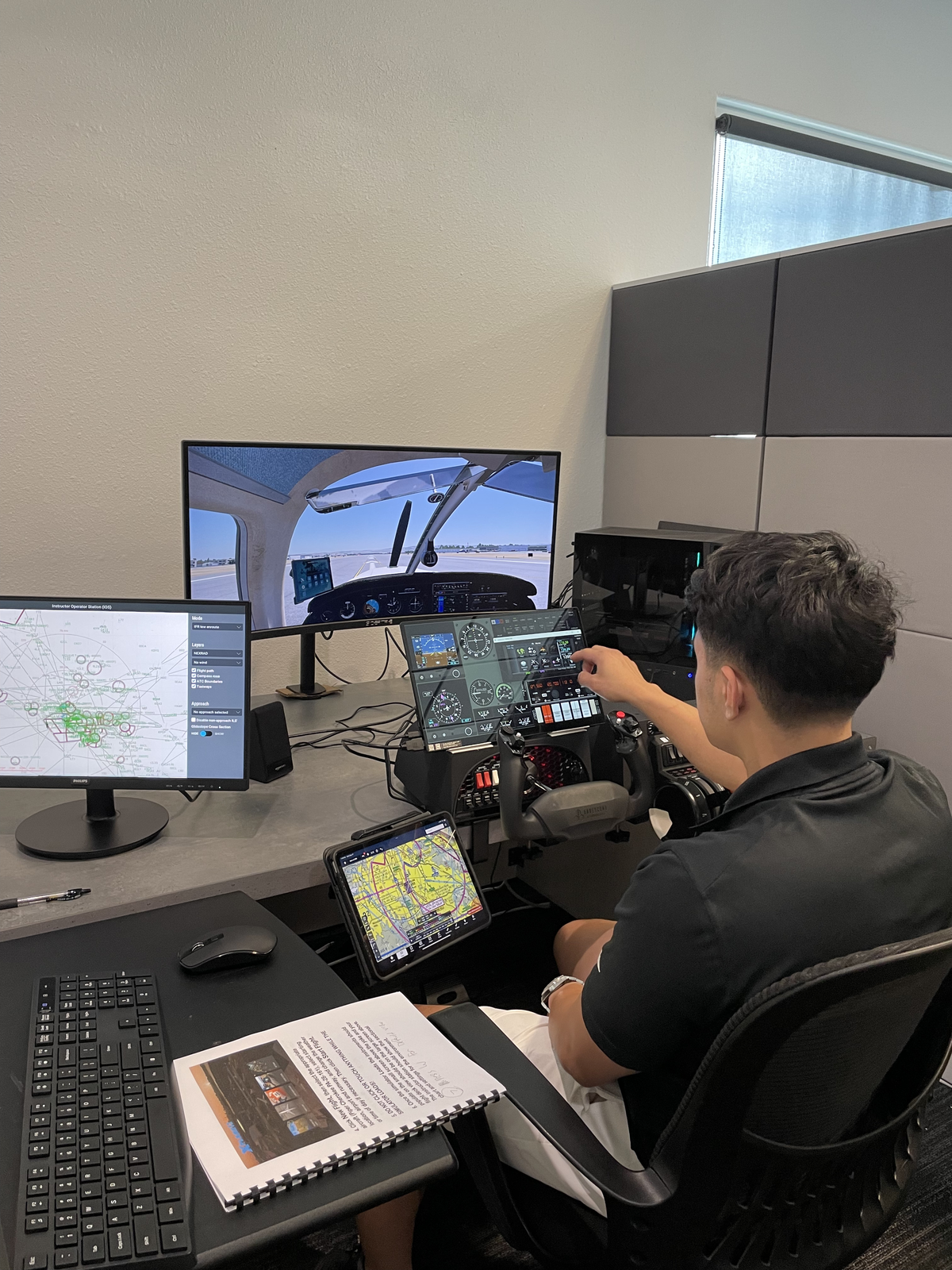
The simulator is where you rehearse before you pay for airplane time. A common session takes 30 to 60 minutes the evening before a lesson. You load the approach you will fly tomorrow, brief the plate, and fly it until the steps feel natural.
Our X-Plane setup works with PilotEdge, a service that lets you practice radio calls with live controllers. Hearing a full clearance and reading it back in the sim makes the real one at Van Nuys much less stressful.
One thing to know: our simulator does not count toward the FAA’s 40 hours of instrument time. Its value is preparation. A hold entry that takes you three tries in the sim takes one try in the airplane, and that saves real money. Our simulator training page has photos of the setup, and our flight simulator guide covers it in depth.
A Typical Day in the Classroom
Ground training is where the rules and the reasoning live. Topics include IFR regulations, the air traffic control system, navigation systems, approach charts, weather, and decision making. These are the same areas the FAA knowledge test covers.
A good classroom session ends with something you can take straight to the airplane. If the class covered holding patterns, your next flight practices them. If it covered weather, you plan your next flight with real forecasts. The FAA’s free Instrument Flying Handbook is a useful companion for reading ahead.
The 15 hours of online video lessons fill the gaps between classes. You can watch them at night, pause on a tricky chart, and come back to a topic before a flight. Our ground school guide explains how students schedule study around work.
How the Three Settings Work Together Over a Week
Here is how a typical week might look for a student flying three times:
- Monday: classroom session on non-precision approaches, then a video lesson at home.
- Tuesday evening: 45 minutes in the sim flying the approach you studied.
- Wednesday: airplane lesson flying that approach for real, with a debrief.
- Thursday: short video review of what went wrong in the debrief.
- Saturday: airplane lesson adding a hold and a missed approach.
Each step feeds the next. By the time you fly a procedure in the airplane, you have already understood it, rehearsed it, and briefed it. That loop is what keeps most of our students on track to finish in about 2 to 3 months. Our instrument rating timeline maps the full program week by week.
What Instrument Training Feels Like Week to Week
The first weeks often feel slow and tiring. Flying by instruments takes a lot of concentration, and an hour under the foggles can feel longer than three hours of VFR flying. That fatigue fades as your scan becomes a habit.
A few habits make those early weeks easier. Sleep well before a lesson, eat before you fly, and keep your first flights of the week short if you are coming off a long workday. Write down one thing to fix after every debrief, then work on that one thing in the sim before the next flight. Small, specific goals add up faster than trying to fix everything at once, and your instructor will notice the difference within a few lessons.
Around the middle of training, approaches start to click. You stop chasing the needles and start staying ahead of them. Near the end, a full IFR flight with a departure, an approach, and a missed approach feels manageable instead of overwhelming. Our instrument rating overview describes the organization habits that get you there.
Paying for Training One Lesson at a Time
You pay for instrument training the way you fly it: one lesson at a time. ActivePILOT uses a pay-as-you-go model with no large advance deposit, so you pay for the instruction and aircraft time you use after each lesson.
If you prefer to spread the cost, we work with Stratus Financial, AOPA Financing, and Columbia Bank. Our financing page explains each option.
Frequently Asked Questions
What do you do in instrument flight training?
You learn to fly the airplane by instruments alone, then navigate, fly holds and approaches, and work with air traffic control under IFR. Training happens in the airplane, the classroom, and the simulator. See our Instrument Rating program for the structure.
How many hours of ground school does instrument training include?
Our program includes 30 hours of classroom ground training and 15 hours of online video lessons, which prepare you for the FAA knowledge test.
Does the simulator count toward my instrument hours?
Our X-Plane simulator is for practice only and does not count toward the FAA’s 40 hours of instrument time. It helps you arrive at each lesson prepared.
What airplanes are used for instrument training?
We train in glass-equipped Piper Warriors, such as N40057 with a GFC 500 autopilot and N41380 with dual Garmin G5s.
Is instrument training harder than private pilot training?
It asks for more concentration and planning. Most students find the first weeks the hardest, and the work gets easier as the scan becomes a habit.
See Instrument Training for Yourself
The best way to know what instrument training feels like is to see the airplanes, the simulator, and the classroom in person. Request information and our team will set up a time to show you around Van Nuys.


